


Insight #7: How Systems Stall Impact
Posted 1 month ago
What happens when R&D exits the lab?
In 2017, we came across a document that helped explain something we were already starting to see: increasing difficulty with turning good ideas into lasting change.
Projects were well-intentioned. The thinking was sound. The evidence was often strong. And yet, once this work encountered the real world, progress slowed or stopped altogether.
This wasn’t isolated. It was happening across different sectors and different types of initiatives. It was also happening within organisations. Here’s how we have addressed it.
Our Insights series shares what we’re hearing from the research community and what some standout organisations are doing differently. It outlines where the constraints lie and what funders, grant managers, and research providers can do to remove them. It’s offered in the spirit of collaboration, with the aim of helping everyone who works in and around research to lift the overall measurability and appreciation of R&D impact.
Seeing the system
That document was Conway, Masters and Thorold’s Design Thinking to Systems Change[1].
Around that time, we were doing a lot of work using systems thinking. For some of our team, this wasn’t new. They had been working this way for decades. What was new was how clearly this lens helped make sense of what we were seeing.
One idea stood out in particular: systems have immune responses.
Whether it’s an industry or an organisation, systems don’t like change – which makes sense when you consider that systems are designed to standardise how things work.
The document included a simple diagram (the one below we now use regularly in workshops) that shows what happens when something new enters an established system. Rather than welcoming the change, the system reacts to protect itself.
It doesn’t matter whether the intervention is clever, well-designed, or backed by evidence. The response is often the same.
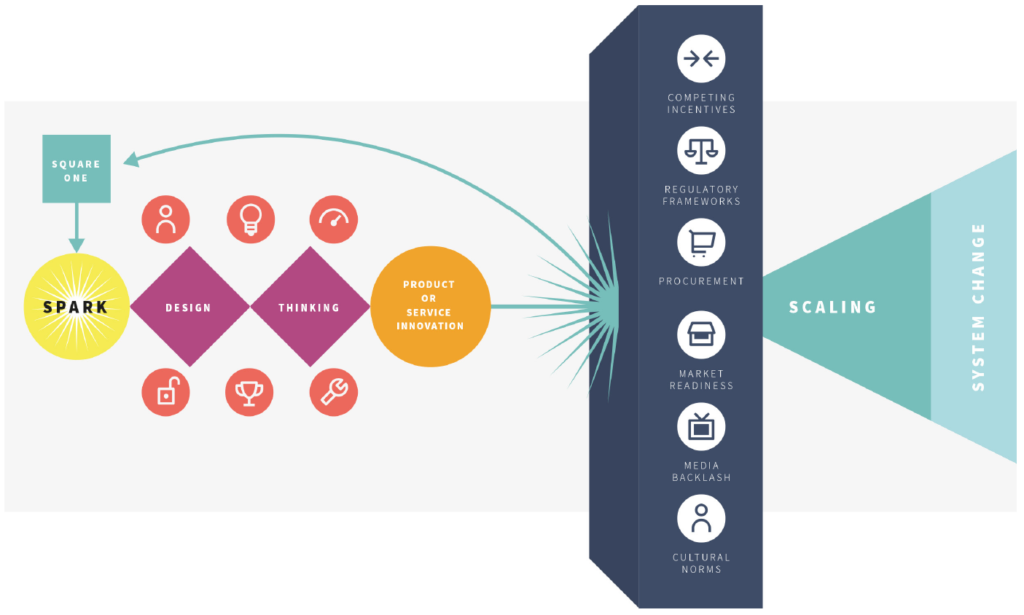
When R&D hits a system
Although the diagram was originally framed in relation to design-led thinking, it quickly became clear that the same pattern applies to R&D.
When R&D outputs encounter a system, they don’t arrive in a neutral environment. They enter a space shaped by existing rules, incentives, funding models, professional identities, and power structures.
The system responds accordingly.
This was an important shift for us. It helped explain why strong research doesn’t automatically lead to adoption, and why promising initiatives can struggle to scale.
The problem wasn’t the quality of the work. It was how the system was responding to it.
Letting go of a comfortable assumption
A comforting idea is that good research will speak for itself – that once the evidence is clear, uptake will follow.
Our experience suggests otherwise.
If you assume that “everyone is going to love this research”, systems behaviour will come as a surprise. If, instead, you assume that change will be resisted, delayed, or reshaped, you start designing R&D projects differently.
Impact then becomes less about persuasion and more about integration.
From insight to practice
This way of thinking has direct input into how we design monitoring, evaluation and learning (MEL) frameworks. It’s also the cornerstone of the R&D Impact Studio, which several funding agencies are now using to optimise project investment.
This approach is based on the simple realisation that systems don’t resist because ideas are bad; they resist because change is disruptive.
To achieve impact, just understanding a system is not enough. It’s about making decisions in complex environments and having effective decision support tools to help navigate the changes required.
Why impact stalls
Seen through this lens, stalled impact is not a failure. It’s a signal.
It tells you that the system is doing its job, which is to maintain stability and standard operating processes. How to decide on what to do next is the critical question.
Once you recognise that R&D triggers system immune responses, the work changes. As well as exploring if something works, you start asking whether it can align to the processes within the system you are trying to change.
That shift doesn’t make impact easier. But it makes it more likely.
Have you noticed similar dynamics in your experience? What’s working well in your field or industry that we should be documenting? Let us know what you think the R&D landscape needs for impact to be recognised and prioritised: community.mgr@impactinnovation.com
[1] Conway, R., Masters, J. and Thorold, J (2017), From Design Thinking to Systems Change, Royal Society for the encouragement of Arts, Manufacturers and Commerce.
Read more: Insight #1 RFP Design and its Influence on Impact | Insight #2 Monitoring & Evaluating Impact | Insight #3 M&E and the Communication Factor | Insight #4 Designing R&D Projects for Impact | Insight #5 Learning from M&E for Impact | Insight #6 Responding to Impact in Grant and Funding Applications